

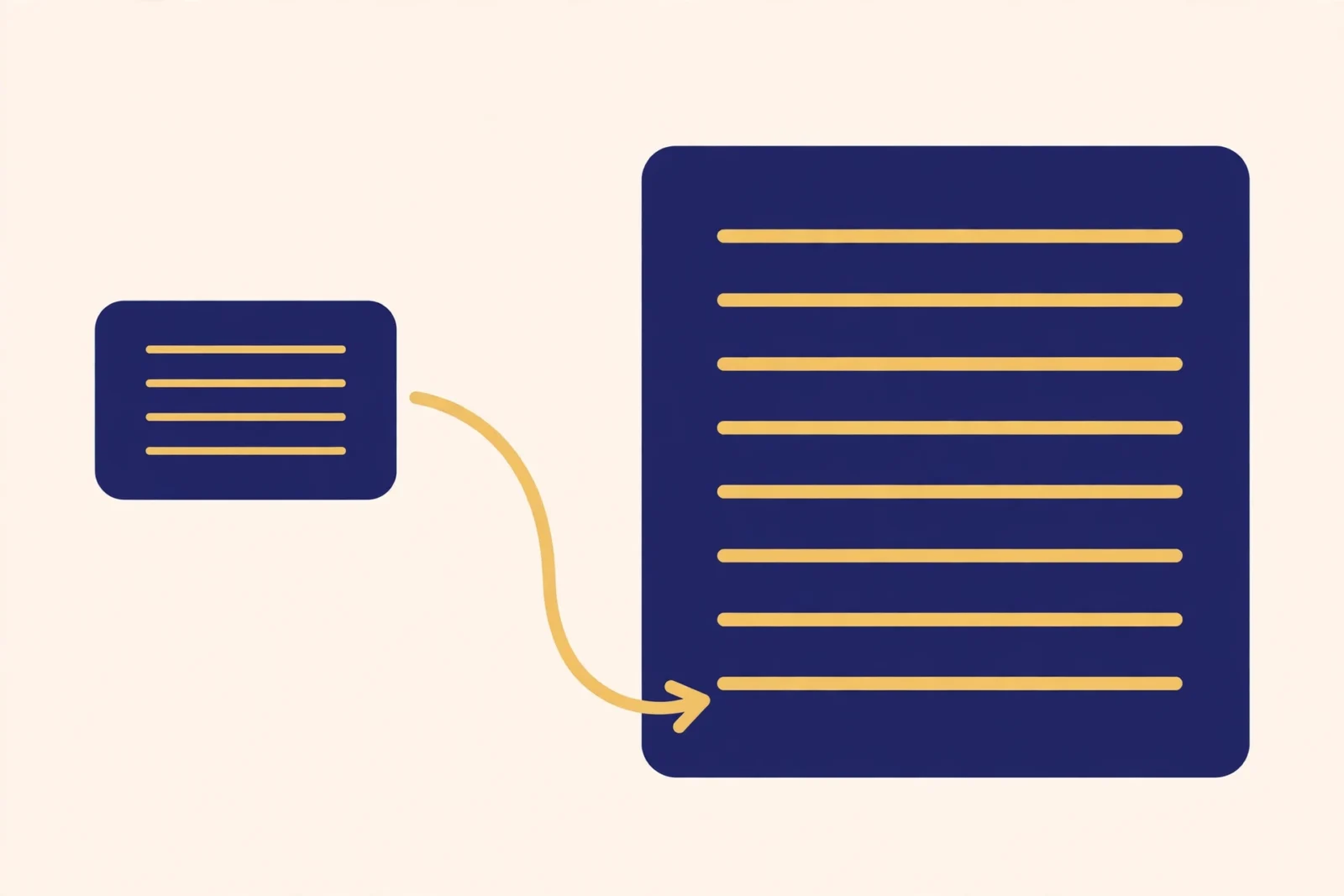
You have written two short sentences, and now you are staring at them. Your assignment needs 300 words. Your blog post feels thin. Your teacher — or your reader — expects more. If you are wondering how to make a paragraph longer without repeating yourself, you are in exactly the right place.
In my content writing classes, I see this problem every single week. A student writes one true, correct sentence… and then stops, because she thinks she has said everything. She has not. A short paragraph is usually not a finished idea. It is a starting idea that needs room to grow.
In this guide, I will teach you 7 easy expansion techniques. Each one comes with a short before-and-after example, so you can see exactly how it works. Let us begin.
The Golden Rule: Expand With Meaning, Not Filler
Before we learn the techniques, let us agree on one rule. When you make a paragraph longer, you must add meaning — new information, a reason, an example, a detail. You must not add filler.
Filler means empty words that say nothing: “very”, “really”, “basically”, “in my personal opinion”. Look at this:
- Thin: “Exercise is good.”
- Padded with filler: “Exercise is really very good, basically, in my personal opinion.”
The second version is longer, but it is worse. Your teacher will notice. Your reader will get bored. Google will get bored too.
Now look at the right way:
- Expanded with meaning: “Exercise is good for both the body and the mind. A short daily walk can lift your mood, and it costs nothing.”
Same idea. More words. But every word earns its place. All 7 techniques below follow this golden rule.
How to Make a Paragraph Longer: 7 Easy Techniques
Here are the seven methods I teach my own students. You do not need all seven at once. Pick one or two per paragraph, and your writing will grow naturally.
Technique 1: Ask the Questions Your Sentence Raises
Every short sentence leaves questions unanswered. Why? How? For whom? What happened next? Answer one of those questions, and your paragraph doubles in size.
- Before: “I started a blog last year.”
- After: “I started a blog last year because I wanted a place to share what I was learning about writing. At first, only my friends read it. Then, slowly, strangers started finding my posts through search engines, and that changed everything.”
The trick is simple: read your sentence, ask “so what?” or “why?”, then write the answer. This one technique alone can rescue most thin paragraphs.
Technique 2: Add One Real Example
An example is the fastest way to add length and clarity at the same time. Readers understand ideas better when they can picture them.
- Before: “A short daily walk keeps you healthy.”
- After: “A short daily walk keeps you healthy. For example, a twenty-minute walk every morning can improve your mood and give you energy for the whole day. You do not need a gym membership. Your street, a nearby park, or even your rooftop is enough to begin.”
Notice the details are specific: twenty minutes, morning, street or rooftop. Specific details always convince more than general claims.
Technique 3: Explain the “Why” Behind Your Point
When you make a claim, your reader silently asks, “Why should I believe that?” Give the reason, and you have a longer, stronger paragraph.
- Before: “The market was crowded.”
- After: “The market was crowded. Shopkeepers called out prices over the noise of rickshaws, and the air smelled of fresh oranges and fried snacks. Bright fabrics hung above the narrow lanes, and I had to walk sideways just to pass through the crowd.”
Do not just name the thing — show it.
Technique 4: Paint a Clearer Picture With Details
Vague writing is short writing. The moment you add concrete details — what something looks, sounds, or feels like — your paragraph stretches out beautifully.
- Before: “Students should read every day.”
- After: “Students should read every day because reading quietly builds the two skills every writer needs: vocabulary and sentence sense. When you read, you collect new words without memorising lists. You also start to feel which sentences sound smooth and which sound broken. That feeling is what turns a weak writer into a confident one.”
One “because” can unlock three more sentences.
Technique 5: Share a Tiny Personal Story
Readers connect with real experiences. A two-line story from your own life can expand a paragraph and make it memorable. This is the technique my students love most, because nobody can copy your story.
- Before: “Learning English changed my life.”
- After: “Learning English changed my life. I still remember reading my first full English novel with a dictionary on my lap. It took me a month. But when I finished the last page, I felt like a door had opened. That one book gave me the courage to start writing — and later, teaching — in English.”
A small, honest memory works perfectly — just keep it short and connected to your point.
Technique 6: Compare It With Something Familiar
A comparison — also called an analogy — explains a new idea by linking it to something your reader already knows. It adds length while making your point clearer.
- Before: “Starting a blog feels difficult at first.”
- After: “Starting a blog feels difficult at first, just like learning to ride a bicycle. In the beginning, you wobble. You fall. You wonder why everyone else makes it look easy. But after a few weeks of practice, your balance comes naturally — and suddenly you cannot imagine why you were ever afraid.”
The pattern is simple: X is like Y because… — then explain the “because”.
Technique 7: Turn One Point Into Simple Steps
If your paragraph gives advice, break that advice into steps. One instruction becomes three, and your reader can actually follow it.
- Before: “You can save money every month.”
- After: “You can save money every month. First, write down everything you spend for one week — most people are shocked by the result. Next, pick one small expense to cut, like daily tea from a café. Finally, move that saved amount into a separate envelope or account on the very first day of the month, before you can spend it.”
Steps are practical, and they naturally organise your paragraph too.
How to Make a Paragraph Longer for Assignments and Blog Posts
The techniques are the same everywhere, but your goal changes with the context.
For school and college assignments, your teacher wants depth. Techniques 1, 3, and 7 (questions, reasons, steps) work best, because they prove understanding — which is what gets marks.
For blog posts, your reader wants value. Longer, in-depth articles keep readers on the page and tend to rank better. Techniques 2, 4, and 5 (examples, details, stories) shine here, because they make your post enjoyable, not just long.
One warning for both: never stretch one weak idea across a whole page. If you truly have nothing more to say, the honest fix is more thinking or more research — not more words.
Frequently Asked Questions
How long should a paragraph be?
There is no strict rule. In blog posts and essays, three to six sentences is comfortable. But unity matters more than length: one paragraph should explore one idea. If your paragraph is short but complete, leave it short.
Is it cheating to make a paragraph longer to hit a word count?
Not if you add real meaning. Expanding with examples, reasons, and details is good writing — that is the skill your teacher wants you to learn. Stuffing sentences with empty filler words is the only kind of “cheating”, and it never works.
Can I use an AI tool to expand my paragraph?
You can use one as a helper, but stay in charge. Read what it produces, keep what sounds like you, delete the rest, and always check the facts. In my AI writing lessons I teach this order: you think first, the tool drafts second, you edit last. Your voice must survive the process.
What if I genuinely have nothing more to say?
Then stop writing and start thinking. Read one more article on the topic, ask a friend their opinion, or narrow your topic to a smaller angle. A thin paragraph usually means thin preparation.
Keep Practising — Length Is a Skill
Learning how to make a paragraph longer is really learning how to think longer about your ideas. Every technique in this guide is a thinking habit: ask a question, find an example, give a reason, add a detail, tell a story, make a comparison, list the steps.
Start small. Take one thin paragraph from your own draft today and apply just two techniques to it. Compare the before and after. I promise you will feel the difference — and so will your reader.
If this helped you, keep learning with me. Two related guides: blog post examples you can model: https://sadiazeeshan.com/blog-post-examples/ — and “is this sentence correct?” simple grammar checks for everyday writing: https://sadiazeeshan.com/is-this-sentence-correct/ — your paragraphs are about to get a whole lot stronger.